


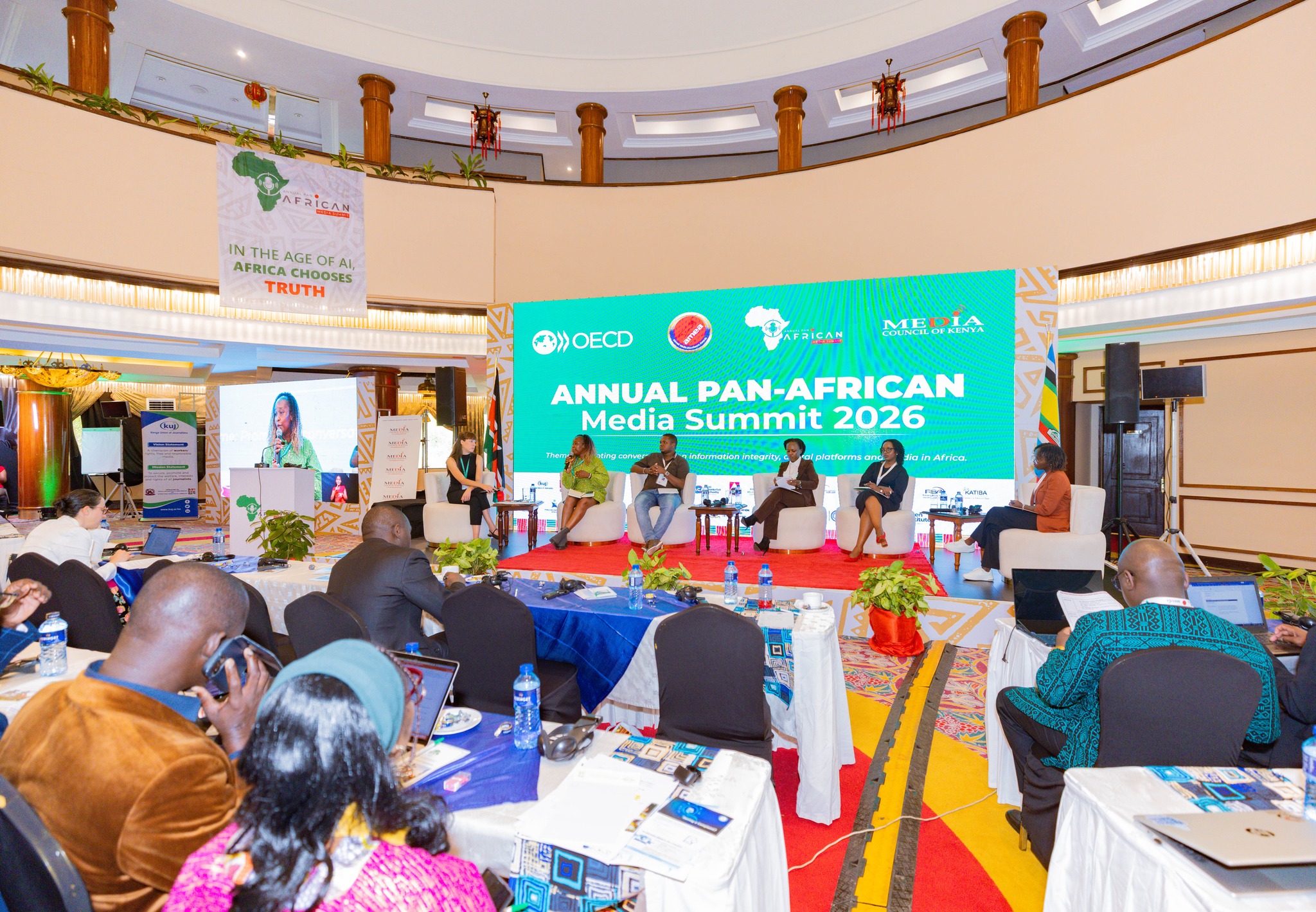
Stakeholders at the inaugural Pan-African Media Summit in Nairobi have called for stronger protection of media freedom, enhanced information integrity, and greater investment in youth empowerment to safeguard democratic governance in Africa’s evolving digital landscape.
The summit, held from May 13 to 15, 2026, brought together policymakers, journalists, editors, technology firms, civil society organizations, academics, regulators, and youth representatives from across Africa and beyond to discuss the future of journalism, digital transformation, and media sustainability.
The event was convened by the Media Council of Kenya in collaboration with the Organisation for Economic Co-operation and Development, Kenya Union of Journalists, Association of Media Women in Kenya, and Kenya Editors Guild.
Speaking during a panel discussion on promoting information integrity for youth, Patriciah Joseph from Katiba Institute underscored the importance of constitutional literacy, civic engagement, and media freedom in strengthening accountability and democratic governance.
She noted that although Kenya’s Constitution contains a progressive Bill of Rights that protects freedom of expression and access to information, challenges remain in fully implementing those rights in practice.
“Access to information remains a powerful accountability tool that enables citizens to participate meaningfully in governance,” she said, adding that young people must be equipped with the skills to understand, defend, and exercise their constitutional rights.
Patriciah said the Katiba Institute has been working to bridge the gap between constitutional ideals and implementation through civic education and legal empowerment programmes targeting young people.
“Our previous Constitution lacked a progressive Bill of Rights,” she said. “The current Constitution protects freedom of expression, and we have built on that foundation by equipping young people with the skills to monitor legislation through a constitutional lens. That capacity has been crucial in identifying and responding to laws that threaten the very freedoms the Constitution guarantees.”
She further raised concerns over threats facing journalists and media institutions, including restrictions on live broadcasts, intimidation, and the use of Strategic Lawsuits Against Public Participation (SLAPP suits) aimed at silencing critical reporting.
“The duty to publish and provide information is still not being fully realised,” she said. “When the government bans coverage of issues, including live broadcasts of protests, it narrows the space for public knowledge and expression.”
Patriciah added that empowering youth to actively participate in governance processes, challenge propaganda, and contribute to informed public discourse is key to protecting democracy and information integrity.
The summit also explored the growing influence of technology and social media on how young people consume information.
Panelists observed that many youths now rely heavily on social media platforms for news due to the rapid growth of digital technology, although they warned that speed and accessibility do not always guarantee accuracy.
Participants expressed concern over the increasing spread and monetisation of misinformation and disinformation online, noting that sensational content often travels faster because it attracts engagement and financial gain.
Panelists emphasized the urgent need for fact-checking, verification, and media literacy to help young people critically assess information and engage responsibly in digital spaces.
Despite the rapid growth of digital platforms, participants noted that radio continues to play a significant role in disseminating information across Africa because of its accessibility and broad reach, especially in rural communities.
They also pointed to the growing preference for short-form digital content, saying audiences, particularly young people, are increasingly consuming information in quicker and more condensed formats.
In a communiqué issued at the end of the summit, participants reaffirmed that access to reliable, accurate, and evidence-based information is critical in promoting democratic governance, development, and freedom of expression.
The summit concluded with calls for stronger collaboration between governments, media organizations, technology companies, and civil society to protect information integrity, strengthen media sustainability, and empower young people with the knowledge and tools needed to navigate complex digital environments responsibly.
What’s happening near you? Send us the story via
news@arisemediagroup.co.ke or WhatsApp 0750456085
Book Advert-use above contacts
 423
423