


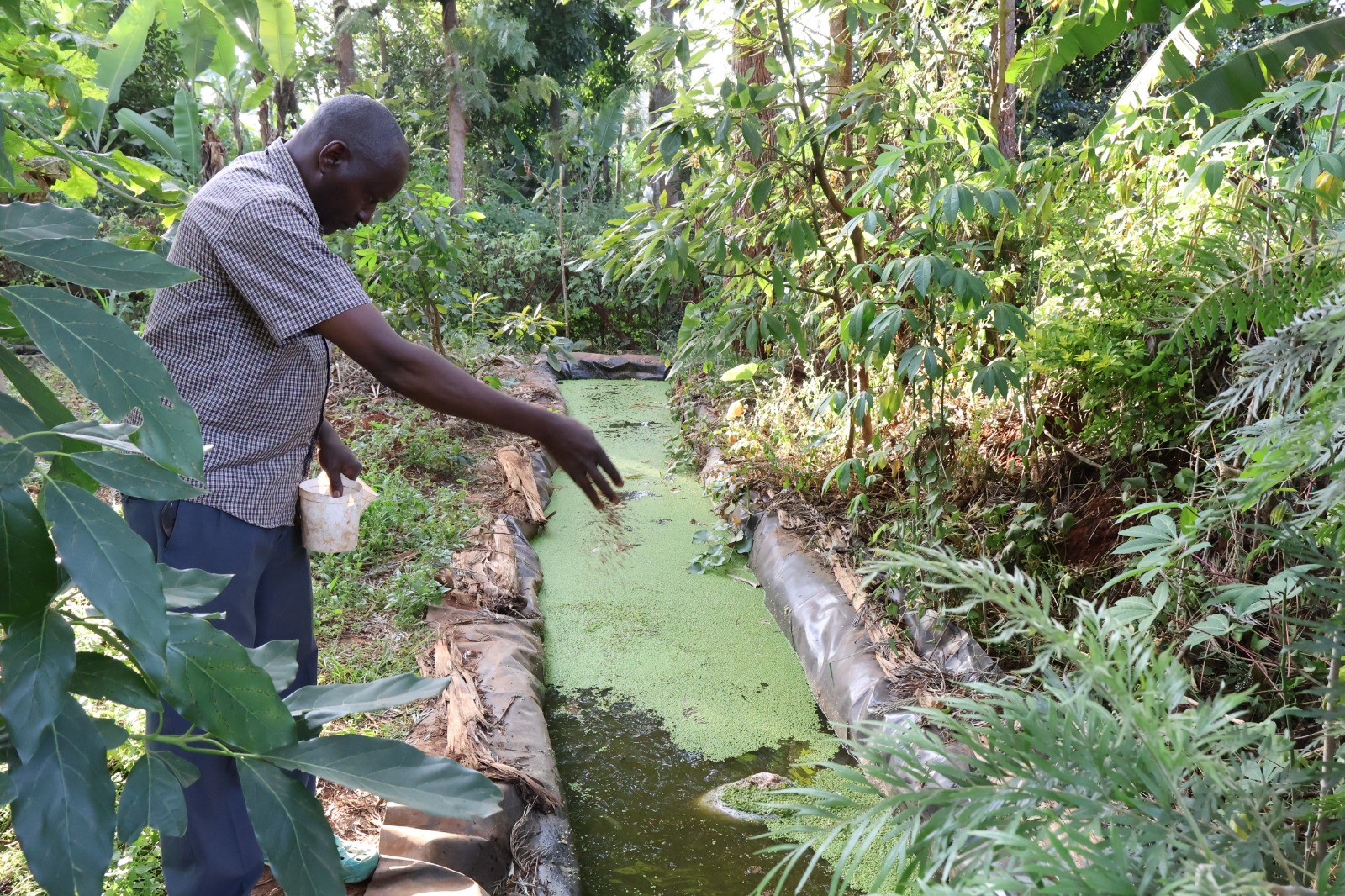
Along the edges of his half-acre family farm in Kiangima, Mutunduri in Manyattat Constituency, Embu County, Sospeter Murithi gently stirs the still waters of a narrow fish pond using a simple stick.
In seconds, the surface bursts into life as hundreds of catfish rush upward.
“This is how I call them for feeding. It also allows fresh air into the water and releases nutrients from the manure sacks inside,” Murithi says.
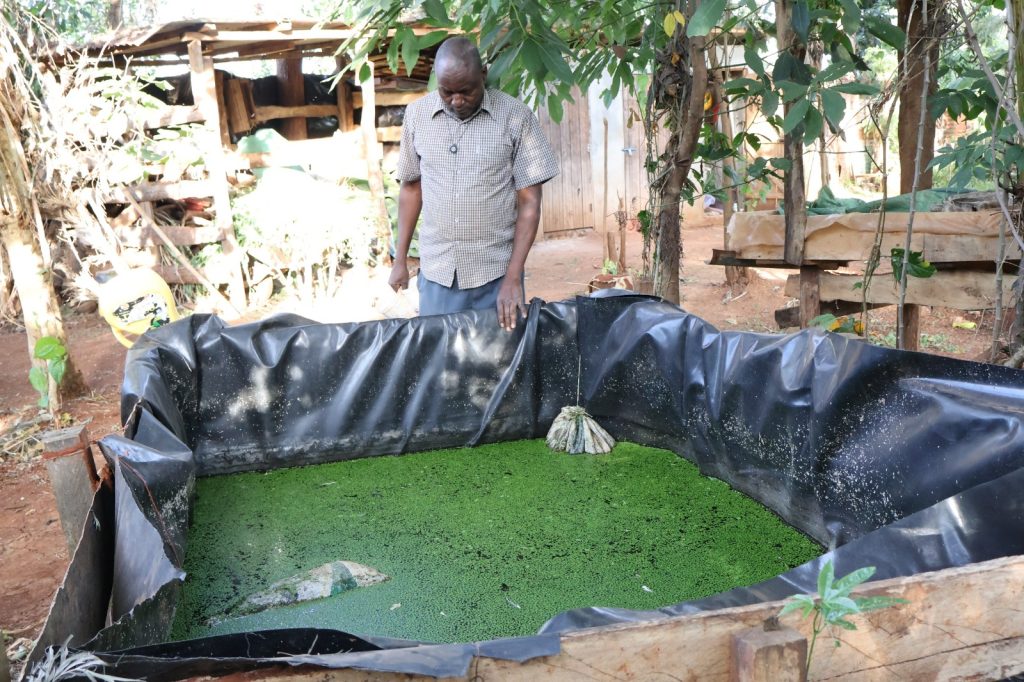
Floating on the pond is a thick green layer of Azolla, an aquatic fern that Murithi considers one of his most valuable resources.
“Azolla is high in protein and can feed fish, poultry, rabbits and even goats. It has helped me reduce feed costs and move away from chemical fertilizers,” he explains.
Murithi, a professional accountant popularly known as Kiano, has turned his small piece of land into a highly integrated regenerative farm—one where crops, animals and insects depend on each other in a carefully balanced system. He calls it farming God’s way.
The project began in 2020, when the COVID-19 pandemic disrupted livelihoods across Kenya.
“That period forced me to rethink life. I started this project when Covid-19 hit, mainly to sustain my family,” Murithi says.
During that time, he made a bold decision to leave the formal employment sector—a move he says he does not regret.
“I do not regret leaving employment. Farming has given me freedom, food security and peace of mind,” he says.
Along the edges of the farm are several 10 by 10-foot fish ponds, each holding at least 50 fish at different stages of growth.
Murithi rears tilapia and catfish, which he says are highly preferred in the region. What began as a family food project has since grown into a business.
“I sell the fish at the newly launched Kangaru Fish Market, fetching up to Sh400 per kilogram,” he says.
A short distance from the ponds is a greenhouse housing thousands of black soldier fly (BSF) larvae, another pillar of the farm.
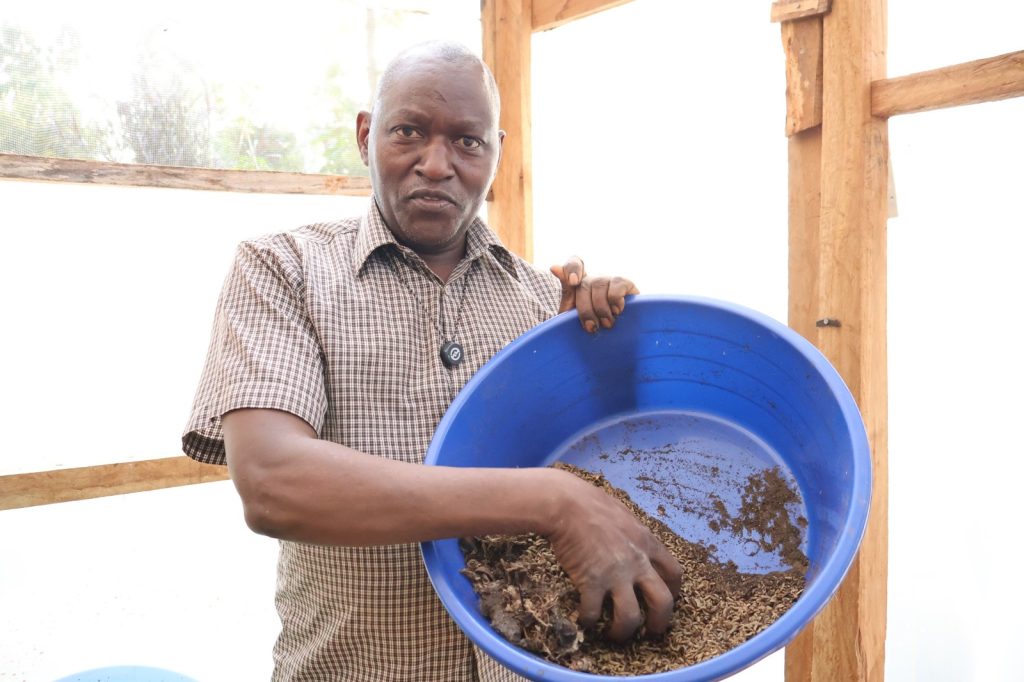
“The feeds I give the fish are supplemented with these larvae. They bridge the protein gap in an affordable and sustainable way,” Murithi explains.
BSF larvae convert organic waste—rotten fruits, kitchen waste, manure and even animal carcasses—into high-protein feed containing up to 60 per cent protein.
The larvae mature within 8 to 14 days, after which Murithi harvests, sieves, kills them using hot water, dries them and mixes them with a small amount of commercial feed.
“Nothing is wasted here. If a fish, chicken or rabbit dies, the larvae handle it,” he says.
NOTE: ARISE MEDIA is now on WhatsApp Channels! CLICK this link to JOIN and read the news in your favourite messenger.
In another corner of the farm, Murithi rears red vigorous earthworms, which he uses to further supplement commercial feeds. The worms, fed on organic matter, provide an additional protein source for fish and poultry, further lowering production costs.
From the worm units, Murithi also harvests nutrient-rich liquid that oozes from the composted material—commonly known as worm tea—which he uses as a foliar spray on crops.
“The water from the worms is very powerful. It improves plant health, boosts growth and reduces the need for synthetic inputs,” he explains.
This closed-loop system has also helped keep the farm clean, earning Murithi membership in the Embu Clean Energy Association.
Goats, poultry and rabbits produce manure that nourishes crops including maize, beans, passion fruits, Hass avocado, oysternut (queen’s nut) and improved Napier grass.
Rabbit urine is used as both fertilizer and foliar spray, while cut jerricans serve as improvised poultry waterers, with Azolla added for feed.
“Everything here is connected. The animals feed the soil, the soil feeds the crops, and the crops feed the animals,” Murithi says.
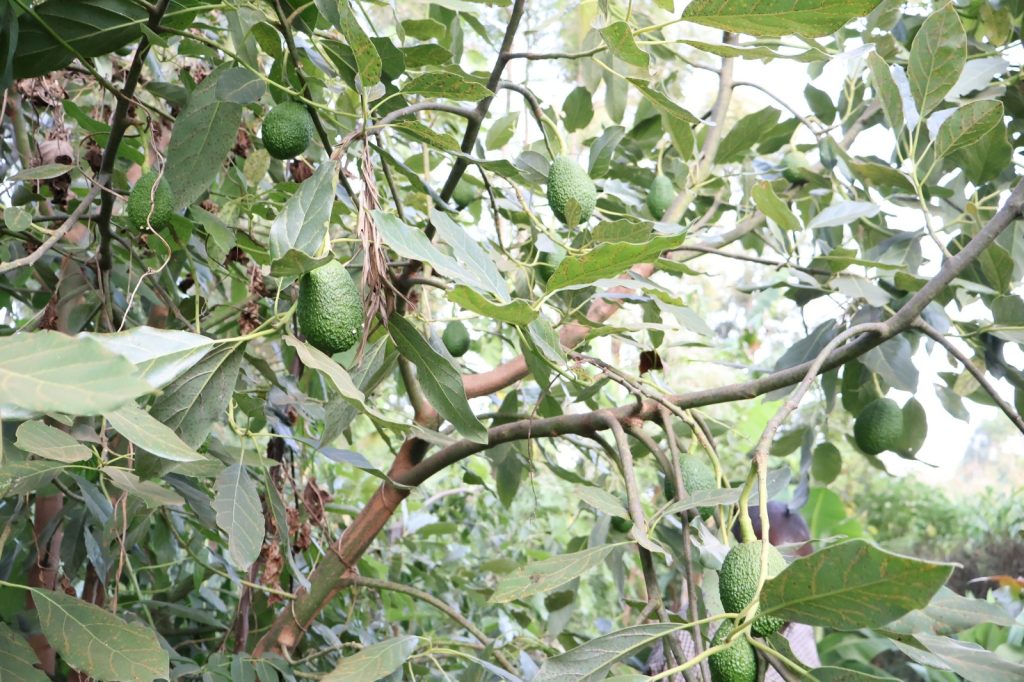
Despite the small land size, the farm provides nearly all his family’s food, with surplus sold for income. Murithi now trains visitors at Sh500 per session, sharing knowledge gained through practice.
“My goal is to show people that even with little land, you can farm sustainably, protect the environment and live well,” he says.
For enquiry, training or farm visits, Murithi can be reached on 0722 317 141.
What’s happening near you? Send us the story via
news@arisemediagroup.co.ke or WhatsApp 0750456085
Book Advert-use above contacts
 659
659